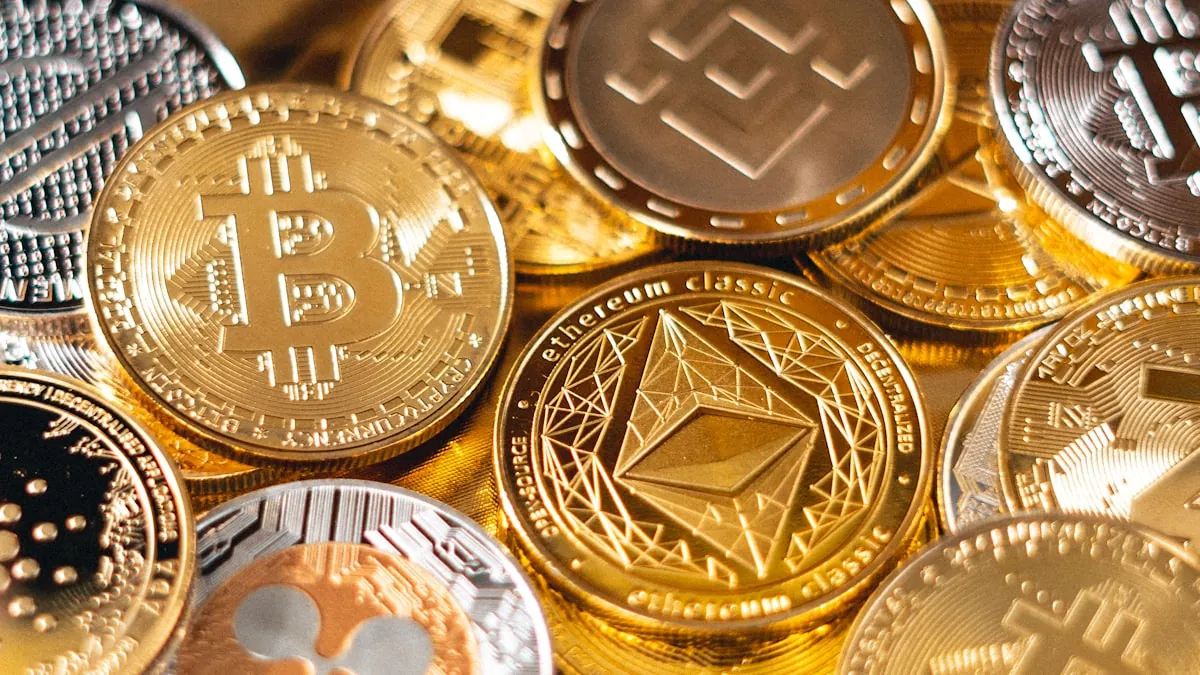
What is USDC and why it works as a digital dollar
USDC (USD Coin) is a stablecoin issued by Circle, pegged 1:1 to the US dollar. Every USDC token in circulation is backed by reserves held in US dollars and short-term US Treasury securities. Not a promise. A verifiable parity.
Unlike volatile cryptoassets such as Bitcoin or Ethereum, USDC was designed to maintain price stability. One USDC equals one dollar. That predictability is precisely what makes it useful as a yield-generating instrument without the volatility rollercoaster.
For anyone living in a country with a depreciating local currency, USDC represents direct access to the dollar economy. No international brokerage accounts, no SWIFT wire transfers, no predatory exchange spreads. You acquire USDC and start operating in the global reserve currency.
USDC is not speculation. It is financial infrastructure denominated in the most liquid currency on the planet.
How Circle guarantees USDC's peg to the US dollar
Trust in stablecoins starts with reserve transparency. Circle publishes monthly attestation reports conducted by Deloitte, one of the Big Four audit firms. These reports confirm that the volume of USDC in circulation corresponds to the value held in reserves.
USDC reserves consist of two categories. First: cash deposits at regulated US financial institutions, including BNY Mellon. Second: short-term US Treasury securities, managed through the Circle Reserve Fund, administered by BlackRock.
This matters for a concrete reason. When SVB (Silicon Valley) collapsed in March 2023 and USDC temporarily lost its peg (dropping to $0.87), Circle demonstrated resilience. Within 72 hours, the peg was restored. The reserve was real. The trust was justified.
In 2026, Circle operates under regulation by the SEC and the New York Department of Financial Services. USDC is not a token of faith. It is a regulated instrument with audited backing.
Why USDC yield outperforms holding depreciating local currencies
Here is the point that many investors in emerging markets have not yet internalized. Holding wealth in a depreciating local currency is accepting a constant, silent erosion.
Consider Brazil as a case study. Over the past decade, the Brazilian real lost more than 50% of its value against the dollar. Local fixed-income instruments delivered nominal returns, but when you discount inflation and currency depreciation, the real return in terms of global purchasing power was minimal. In many periods, negative.
The math is stark. Between 2015 and 2025, Brazilian CDI (the local benchmark rate) accumulated approximately 130% in nominal returns. Over the same period, the dollar went from R$2.65 to above R$6.00. Anyone who held wealth in reais, even earning CDI, lost international purchasing power.
This pattern repeats across emerging markets. The Turkish lira, Argentine peso, Nigerian naira. Local yields look attractive in nominal terms but dissolve when measured against the dollar.
USDC yield inverts the equation. Your capital is denominated in dollars. The return is calculated on a dollar base. You protect against local currency depreciation and generate return on the dollar simultaneously.
Nominal yield vs. real yield: the local currency trap
A local bond may yield 12% annually in nominal terms. But if inflation runs at 5% and your currency depreciates 15% against the dollar in the same period, your wealth shrank in global terms. Yield on USDC removes the currency variable from the equation. Your capital grows on a stable base.
How to earn yield on USDC through audited DeFi protocols
Yield on USDC does not come from nothing. It comes from decentralized finance protocols that connect capital suppliers with borrowers. The logic mirrors traditional credit markets, but without intermediaries capturing the margin.
The three primary mechanisms in the DeFi ecosystem are:
Lending. You deposit USDC into a lending protocol such as Aave. Borrowers pay interest to use that capital as collateral or leverage. You receive a share of that interest, proportional to your deposit. Rates in April 2026 range between 3% and 7% annually, depending on borrowing demand. Chainless specifically uses Aave on Base chain to offer dollar-denominated yield to its users.
Liquidity provision. Decentralized exchanges (DEXs) like Uniswap and Curve need liquidity to function. You deposit USDC into liquidity pools and earn a fraction of the trading fees paid by users who swap tokens. Typical returns range from 5% to 12% annually, with impermanent loss risk in volatile asset pools. Stablecoin pools (USDC/USDT, for example) minimize this risk.
Optimized vaults. Platforms like Yearn Finance create automated strategies that combine lending, liquidity provision, and protocol incentives to maximize returns. You deposit USDC and the vault continuously rebalances the allocation. These products are more complex and carry additional risks from protocol composability.
Each mechanism carries a different risk profile. The rule is direct: the higher the promised return, the greater the complexity and risk involved.
Chainless and Aave: the choice for simplicity and security
Chainless specifically uses the Aave protocol on the Base network to generate USDC yield. Aave is the largest decentralized lending protocol, with over five years of operation and multiple security audits. The choice of a single audited, battle-tested protocol, rather than multi-protocol strategies, prioritizes security and transparency over marginally higher returns.
Real risks of earning USDC yield and how to mitigate them
Yield in DeFi is not risk-free. Pretending otherwise would be dishonest. Let us map the concrete risks and the ways to manage them.
Smart contract risk. DeFi protocols operate via smart contracts. If there is a vulnerability in the code, funds can be drained. Mitigation: use only protocols with multiple audits from recognized firms (Trail of Bits, OpenZeppelin, Spearbit) and extensive operating history. Aave, for example, has operated for over five years without critical incidents in its core contracts.
Depeg risk. Although USDC maintains consistent parity with the dollar, extreme events can cause temporary deviations. Circle's response to the SVB episode demonstrated recovery capability, but the risk exists. Mitigation: diversify across stablecoins when possible and maintain a liquidity reserve.
Protocol risk. Governance changes, code upgrades, or DAO decisions can alter yield conditions or introduce new risks. Mitigation: follow the governance of protocols you use and prefer protocols with transparent governance and a track record of conservative decisions.
Regulatory risk. Legislation can change and impact DeFi protocol operations or the tax classification of stablecoin yields. Mitigation: maintain detailed records of all operations and consult tax professionals specialized in digital assets.
Zero risk does not exist in any investment. What exists is intelligent risk management. In DeFi, that means audited protocols, diversification, and self-custody.
USDC yield with self-custody: why custodial platforms destroy the value proposition
Here is the contradiction many platforms ignore. Earning yield on USDC is powerful. But if you must surrender custody of your assets to an intermediary to access that yield, you are trading one risk (local currency depreciation) for another (counterparty risk).
The collapse of platforms like Celsius, Voyager, and FTX between 2022 and 2023 wiped out billions in user wealth. Those users had yield on their screens. They did not have the assets.
Self-custody resolves this. With non-custodial wallets and direct access to DeFi protocols, your USDC never leaves your control. You interact with smart contracts, not companies. Yield flows directly to your wallet. No intermediary can freeze, withhold, or lose your funds.
Chainless operates on this principle. Your digital wealth stays under your custody via an MPC wallet, without needing to manage seed phrases. Yields are generated through Aave on the Base network. The platform facilitates access but does not touch your assets. If Chainless ceases to exist tomorrow, your USDC remains in your wallet, earning yield.
Yield without custodial risk: the standard 2026 demands
Any platform that requires you to transfer your assets to generate yield is operating on the model that failed in 2022. The 2026 standard is yield with self-custody: your capital, your control, your returns. No intermediaries in the value chain.
Comparing USDC yield vs. local bonds vs. savings accounts vs. holding idle dollars
To make the decision tangible, let us compare four scenarios for a $10,000 equivalent investment over 12 months, using April 2026 data.
Local high-yield savings or bonds. Nominal yield varies by country: 11.5% in Brazil (CDI), 45% in Turkey, 8% in Mexico. Sounds attractive. But subtract local inflation and currency depreciation against the dollar, and real returns often shrink to near zero or turn negative.
US Treasury Bills (direct). Yield of approximately 4.5% in April 2026. Requires a US brokerage account, SSN or ITIN, and involves regulatory complexity for non-US residents. Accessible, but with friction.
Holding dollars idle. No yield. Protects against local currency depreciation, but idle dollars do not work. After 12 months, you have the same dollars you started with. Inflation still erodes purchasing power at approximately 2.5% annually.
USDC with DeFi yield (5% annually, conservative). Your capital is in dollars from day one. Earning 5% annually on the dollar base. After 12 months, you have 5% more dollars. No brokerage account required. No geographic restrictions. Accessible from any wallet, anywhere.
The structural difference is that USDC yield protects against local currency depreciation and generates return simultaneously. The alternatives do only one of these things, or neither.
Step-by-step guide to start earning yield on USDC today
If you have read this far, you have the context. Now, the execution.
1. Acquire USDC. You can purchase USDC through Chainless or through exchanges that operate in your region. Prefer platforms that deliver USDC to your self-custody wallet, not ones that hold it under their custody.
2. Secure self-custody. Transfer your USDC to a non-custodial wallet. Chainless offers an integrated MPC wallet without needing to manage seed phrases, with full user control. Your keys, your wealth.
3. Activate yield via Aave. With Chainless, the process is straightforward: deposit USDC and it begins earning yield automatically via Aave on the Base network. Yield varies with lending market demand, historically ranging between 3% and 7% annually. No lock-up period, with redemption available at any time.
4. Monitor and rebalance. Yield rates in DeFi fluctuate with supply and demand. Review your position periodically. Chainless displays accumulated yield directly in the app.
5. Maintain records. Document every deposit, every withdrawal, every yield received. This will streamline tax reporting and protect you in case of audit.
The USDC yield landscape for global investors in 2026
The macroeconomic context of 2026 makes USDC yield particularly relevant for investors in emerging markets.
Central banks across Latin America, Africa, and Southeast Asia maintain elevated interest rates, but persistent inflation erodes nominal gains. Local currencies face structural depreciation pressure. And the digitization of finance has accelerated stablecoin adoption globally, with transaction volumes exceeding $3 trillion in 2025 according to Chainalysis data.
Brazil alone transacted over $90 billion in stablecoins in 2025, leading Latin America. But the pattern extends to Nigeria, Turkey, Argentina, Vietnam, and dozens of other markets where citizens seek dollar exposure as a hedge against local currency instability.
Investors in these markets already understand the thesis. What many lack is the next step: putting those digital dollars to work. Yield on USDC via DeFi with self-custody is that step. It is not complex. It does not require advanced technical knowledge. It requires clarity about what you want: protected wealth, denominated in dollars, generating real returns, under your control.
Local currencies depreciate. Digital dollars earn yield. The choice is yours, but the numbers do not lie.
Understanding USDC yield in the context of traditional dollar investments
Some readers may wonder: why not just invest in US Treasury bonds or dollar-denominated ETFs? Fair question.
The answer comes down to three factors: access, custody, and efficiency.
Access. Opening a US brokerage account as a non-US resident involves KYC friction, tax treaty complications, and often minimum balance requirements. USDC yield via DeFi is permissionless. A wallet and an internet connection are the only requirements.
Custody. When you hold assets through a brokerage, that brokerage is the custodian. If the brokerage faces insolvency or regulatory action, your assets may be frozen. With self-custodied USDC in DeFi protocols, no single entity holds your funds.
Efficiency. Traditional finance settles in T+1 or T+2. DeFi settles in seconds. Yield accrues in real time, not quarterly. You can enter and exit positions without waiting for market hours. The infrastructure runs 24/7/365.
This does not mean DeFi yield replaces traditional dollar investments entirely. For large institutional allocations, regulated instruments remain appropriate. But for individuals seeking dollar-denominated yield with sovereignty over their assets, USDC in DeFi protocols offers a combination that traditional finance cannot match.
Conclusion: USDC yield as a wealth preservation and growth strategy
USDC yield is not a trick. It is the convergence of three powerful forces: the stability of the dollar, the efficiency of audited DeFi protocols like Aave, and the security of self-custody.
For investors in emerging markets, this combination solves a real problem. Protecting wealth against local currency depreciation while generating return on a dollar-denominated base. Without intermediaries capturing margin. Without custodial platforms creating counterparty risk.
The infrastructure exists. The protocols are mature. Regulation is consolidating. What remains is a decision. Understanding that keeping wealth idle in a depreciating local currency, even earning local interest rates, is accepting a slow and constant loss in global terms.
Your digital dollars can work for you. Every day. Under your control. That is the concept of USDC yield. And it is accessible now.
Dollar-denominated yield with self-custody
With Chainless, your USDC earns yield through Aave, one of the most audited DeFi protocols in the market, while remaining under your full control. No intermediaries, no custodial risk. Dollar-denominated wealth that works for you, 24 hours a day.
See how it worksPerguntas frequentes
Is earning USDC yield safe compared to traditional savings accounts?
USDC is a stablecoin backed 1:1 by US dollars and short-term US Treasury securities, with reserves attested monthly by Deloitte. The risk of losing its dollar peg is historically low. Safety depends on the DeFi protocol used, but with audited protocols and diversification, the risk profile is manageable and often compares favorably to holding local currencies that depreciate against the dollar.
How much yield can USDC generate in DeFi protocols in 2026?
Returns vary by protocol and strategy. As of April 2026, conservative lending strategies on protocols like Aave offer between 3% and 7% annually on USDC. Chainless specifically uses Aave on the Base network, with variable yields driven by lending market demand. More advanced strategies on other protocols, such as liquidity provision, may offer different returns with proportionally higher risk.
Do I need to pay taxes on USDC yield?
In most jurisdictions, yes. Yield earned on USDC through DeFi protocols is generally considered taxable income or capital gains. Rules vary by country. Keep detailed records of all transactions, including dates, amounts, and dollar values. Consult a tax professional familiar with digital assets in your jurisdiction.