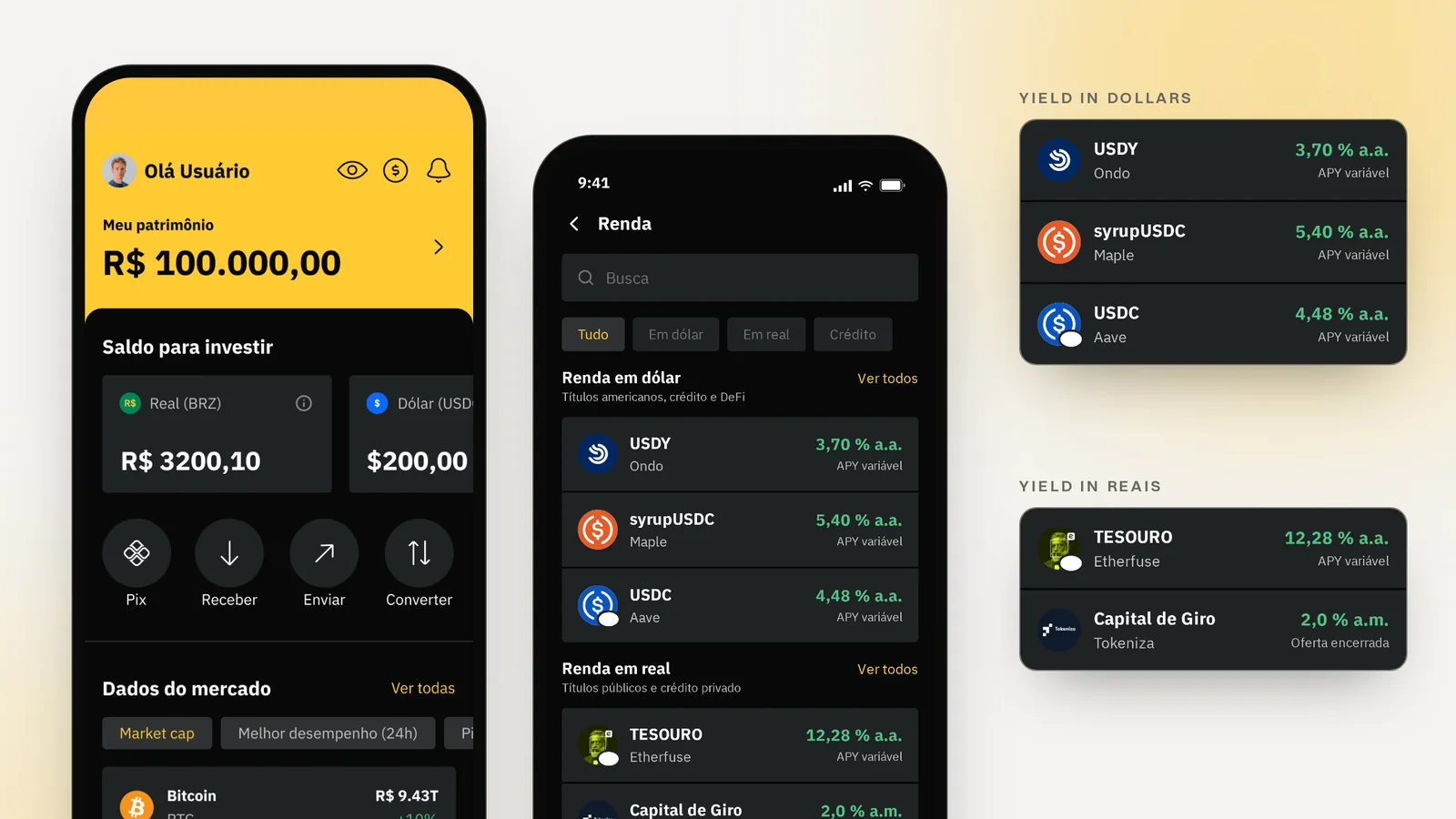
Picture three investors.
The first runs a business in Brazil. He needs to keep funds available in reais to pay suppliers, staff and expenses, but wants to depend less on a single financial institution.
The second is building a long-term reserve. She does not need all her money in reais and prefers to hold part of her wealth in dollars, with less exposure to Brazil’s economic uncertainty.
The third already has a diversified portfolio: reserves, traditional investments and international exposure. Now they are looking for higher yields, even if that means taking on extra risk with a slice of their wealth.
All three want their money to earn. But it would be a mistake to recommend the same investment to all of them.
The best investment is not necessarily the one with the highest return. It is the one that does the right job inside your portfolio.
On Chainless you will find different ways to earn in reais and in dollars, through tokenized government bonds, private credit and decentralized finance (DeFi) protocols.
They are very different from one another. Some put the quality of the underlying assets first. Others offer potentially higher returns in exchange for more risk. Some give you relatively easy access to liquidity; others call for planning and a longer horizon.
In this guide we explain how each one works, what its main risks are and, above all, who each one makes sense for.
Before talking about yield, we need to talk about freedom
For decades, investing meant entrusting your wealth to banks, brokers and other institutions.
Those institutions still play important roles. But concentrating all of your wealth with traditional intermediaries also means depending on their rules, their infrastructure, their availability and the political and economic conditions they are subject to.
For anyone seeking long-term financial security, there is a question that goes beyond returns:
How much control do you really have over your own money?
Chainless exists to offer an alternative.
With self-custody, your digital assets sit in a wallet you control, without Chainless having to hold your money or approve each transaction. The blockchain lets you transfer and use assets directly, reducing the need for intermediaries to execute transactions.
This does not remove investment risk or the issuers’ rules. But it opens an important possibility: building wealth with more autonomy, diversification and privacy.
And there is a particularly interesting evolution of this model.
You do not have to choose between keeping your wealth in digital assets and putting your money to work.
Today you can access Brazilian government bonds, instruments tied to US Treasuries and different kinds of credit through tokenized assets.
In practice, that means combining familiar financial instruments with an infrastructure that gives you more control over ownership and movement of the assets.
That combination of financial autonomy and yield is what we will explore.
“Fixed” income on the blockchain: what does it really mean?
When people hear fixed income, most think of bank CDs, Tesouro Direto, LCIs, LCAs or fixed-income funds.
Those products have specific financial and legal structures. On Chainless, the yield opportunities are not necessarily equivalent to those traditional investments.
We are talking about assets and strategies that aim to generate relatively predictable returns in a given currency, using different mechanisms.
To make sense of the options, it helps to split them into three categories.
Tokenized government bonds. Digital instruments economically linked to debt issued by governments. The return comes from the interest those bonds pay, according to each product’s structure.
Tokenized private credit. The investor finances companies or credit operations and is paid for the capital lent. The return depends on the agreed terms, the borrowers’ ability to pay and the collateral in place.
DeFi lending. The investor supplies assets to decentralized protocols. Other participants can borrow them against collateral, paying interest set by market conditions and the smart contracts’ rules.
Every one of these carries risk. None of them, simply by being on a blockchain, guarantees a return or full preservation of capital.
It is also important to separate two things: an investment can accrue yield over time and still swing in price in the short term. Depending on the asset, the liquidity available and market conditions, selling a position early can mean receiving less than its expected economic value.
That is why this article does not focus on speculative investments or strategies heavily exposed to crypto volatility.
We will look at alternatives built for generating income and growing wealth in a reference currency.
Which brings us to the first big decision.
Should your wealth earn in reais or in dollars?
Before comparing rates, you need to choose the currency in which you will measure your results.
On Chainless there are two broad paths: yield denominated in reais and yield denominated in dollars.
It sounds like a simple distinction, but it changes the whole strategy.
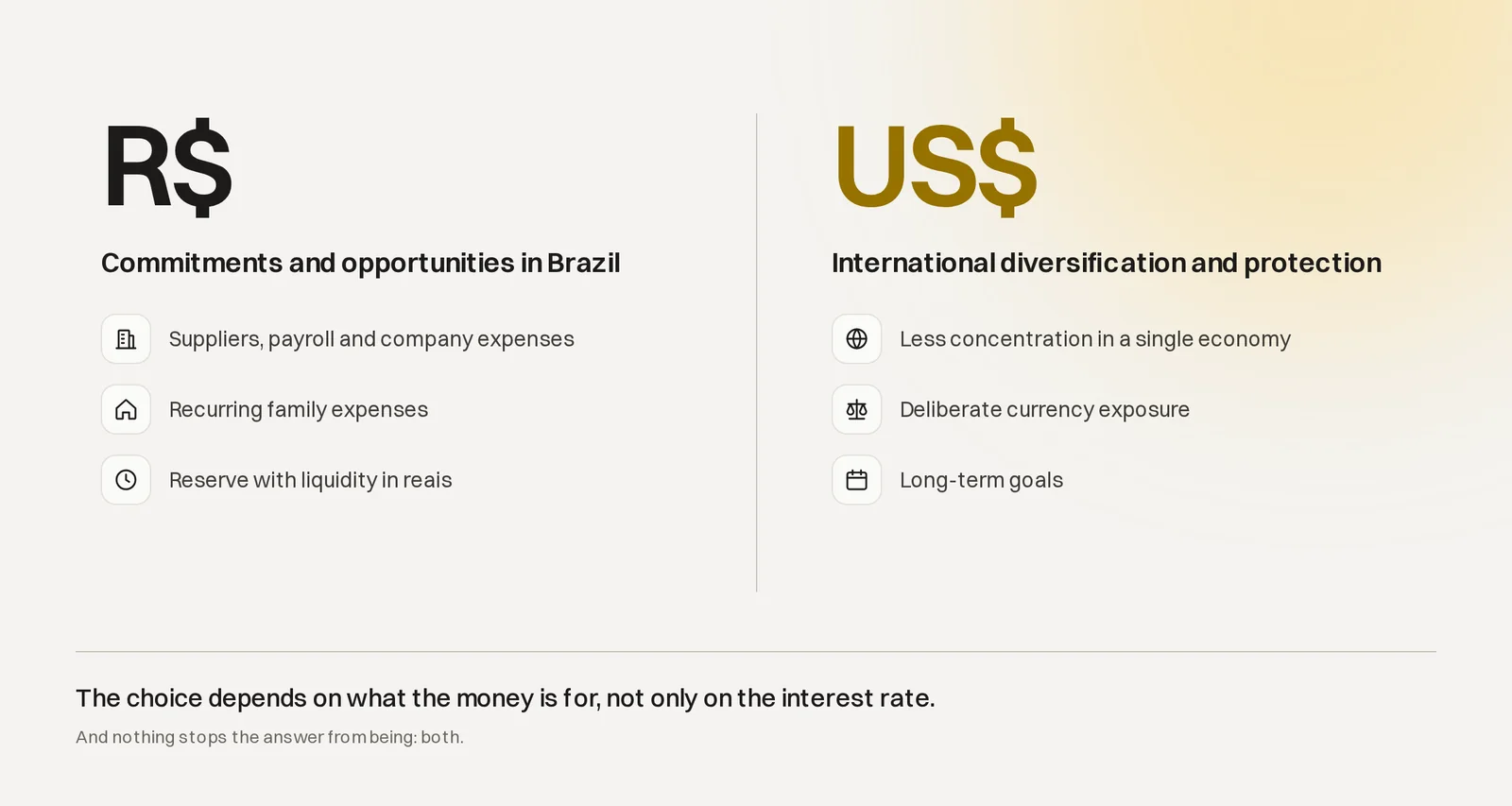
Yield in reais: for commitments and opportunities in Brazil
If you earn, spend and owe in reais, keeping part of your wealth in that currency is a natural decision.
Think of a Brazilian company that pays suppliers every month, or a family with recurring expenses in the country.
They need liquidity in reais. It makes no sense to expose all that money to the dollar’s swings when the commitments already have an amount and a date set in Brazilian currency.
On top of that, Brazil has historically offered high nominal interest rates compared with developed economies.
That creates yield opportunities, but it also demands attention to country risk, inflation and the structure of each investment.
Yield in dollars: for diversification and international protection
Now picture another situation.
You already own property, businesses, investments and sources of income in Brazil. Much of your wealth is naturally tied to how the Brazilian economy performs.
In that scenario, holding a slice in dollars can help reduce concentration in a single currency and economy.
The dollar is widely used in international trade and financial markets. Holding investments denominated in it can be a way to diversify your wealth without betting on the exchange rate in the short term.
And there is an important difference between simply holding digital dollars and owning assets that earn a return on those dollars.
With a conventional stablecoin such as USDC or USDT, you are exposed to the value of the dollar, but simply keeping the token in your wallet earns no interest.
Instruments such as Ondo’s USDY aim to offer that same currency reference together with a return linked to US government securities.
It is a way to put part of your dollars to work.
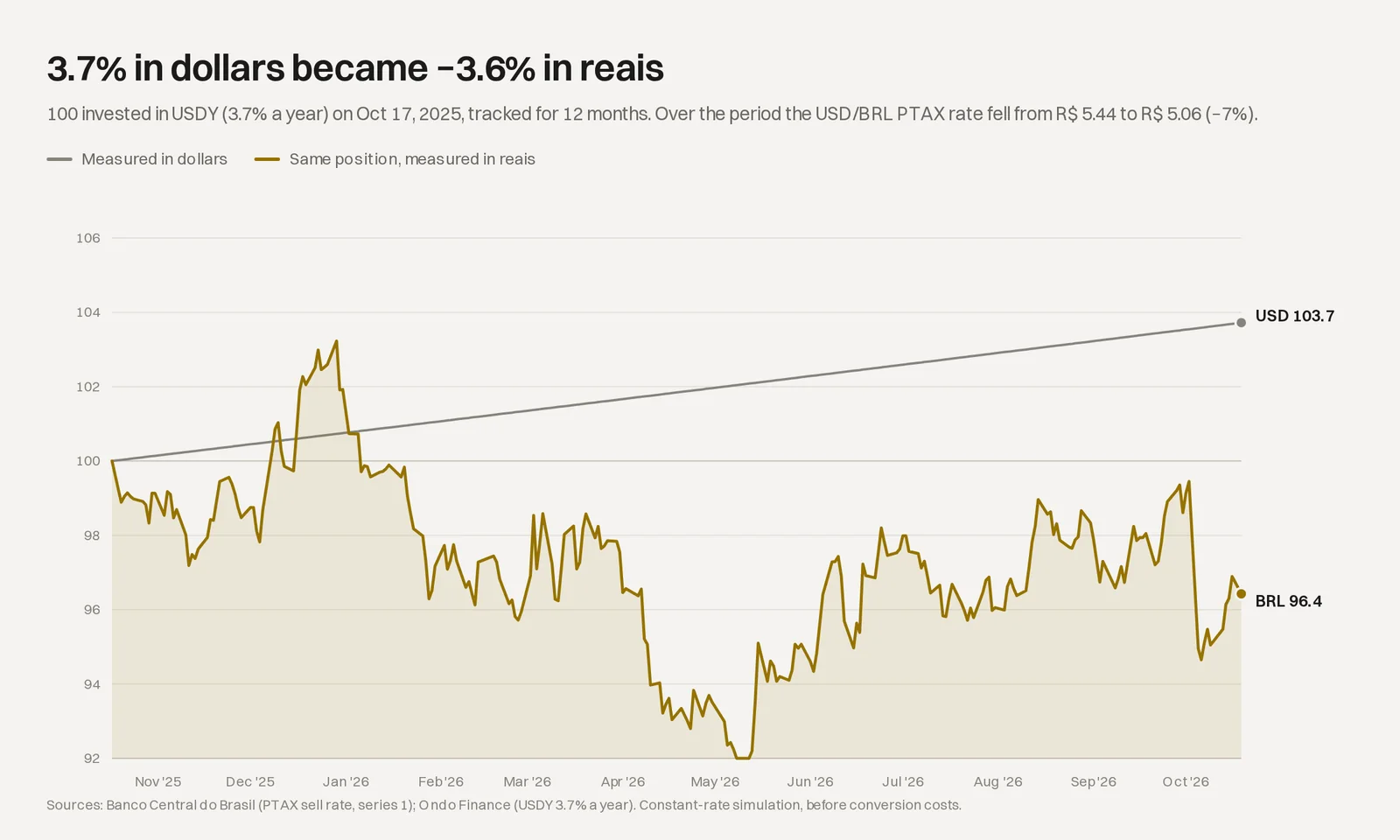
But be careful: earning 4% in dollars is not the same as earning 4% in reais. If the real strengthens against the dollar, the return converted into reais can shrink or even turn negative. That is exactly what happened over the last 12 months.
So the question is not which currency pays more interest today. It is in which currency you want to hold that slice of your wealth.
And nothing stops the answer from being: both.
Meet the five yield alternatives
To make the comparison easier, here are the main characteristics of the opportunities covered in this guide.
| Product | Currency | Source of yield | Reference return | Main role |
|---|---|---|---|---|
| TESOURO (Etherfuse) | Real | Brazilian government bonds | About 90% of CDI | Financial autonomy and liquidity in reais |
| Private credit (Tokeniza) | Real | Loans to companies | Some offers above 180% of CDI | Seeking higher return with a diversified slice |
| USDY (Ondo) | Dollar | Short-term US Treasuries and bank deposits | About 3.7% a year | Preservation and diversification in dollars |
| Maple | Dollar | Collateralized institutional credit | Up to about 5.4% a year, depending on strategy | Higher dollar yield through credit |
| Aave | Dollar | Collateralized decentralized lending | About 4.5% a year at the reference used | DeFi diversification and market rates |
Reference rates for this edition, October 2026, with CDI at 13.65% a year. They are variable or offer-specific and are not promises of return. Check current figures and terms in the app. Liquidity differs across products and is discussed below.
At first glance it may look like you just pick the highest rate.
But this is exactly where the most important part of the analysis begins.
A Brazilian government bond, a real-estate credit deal and a DeFi protocol can all pay yield in the same currency while carrying completely different risks.
Let’s go through each of them.
Yield in reais
We start with the everyday currency: two alternatives with opposite propositions, one built around autonomy and liquidity, the other around return.
Etherfuse’s TESOURO: when autonomy and liquidity matter more than maximizing CDI
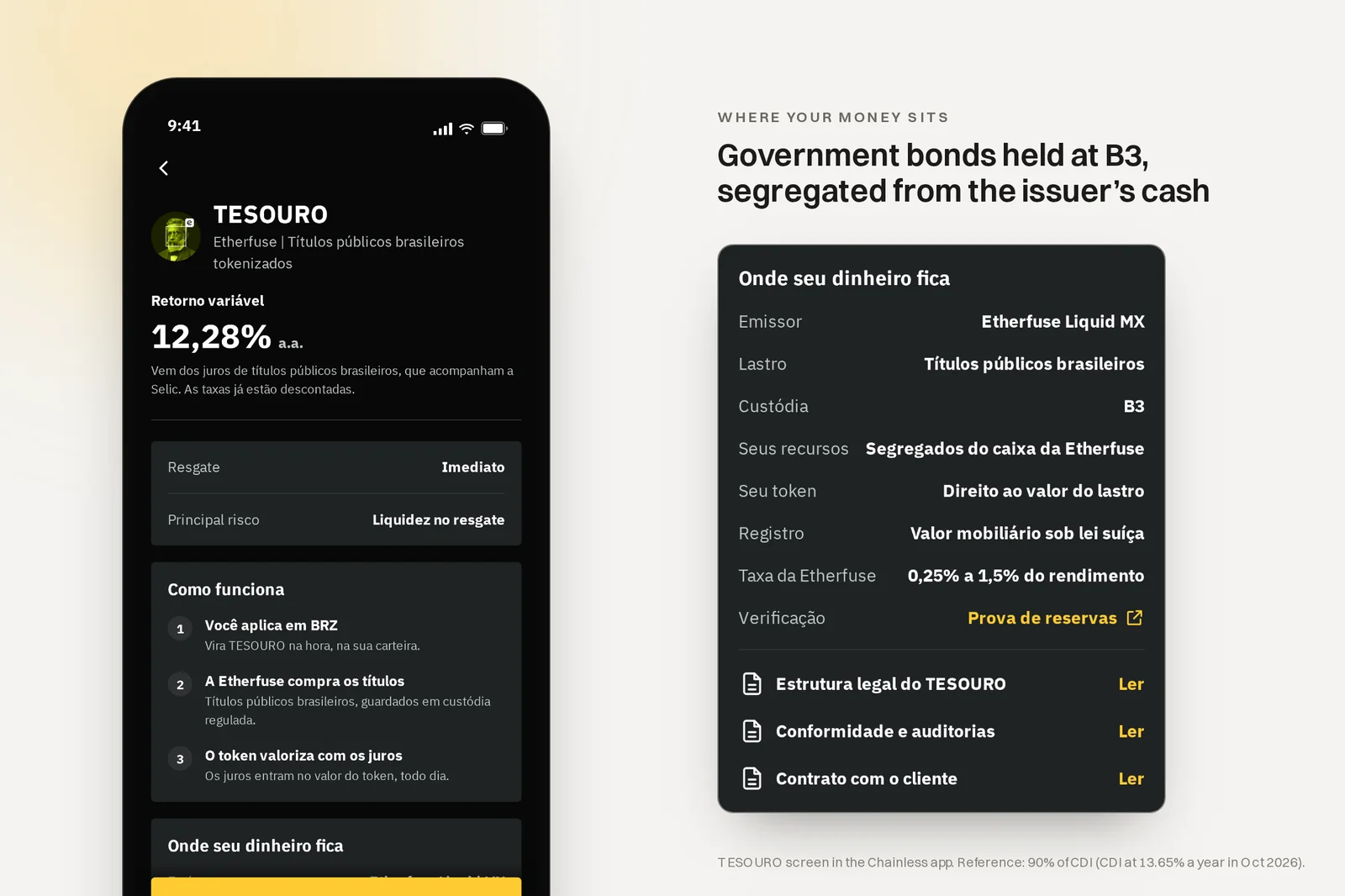
TESOURO, issued by Etherfuse, is a way to gain economic access to Brazilian government bonds through the blockchain.
The structure uses federal government bonds held within the traditional financial system, with custody registered at B3. Etherfuse represents the economic rights to those assets through digital tokens called TESOURO.
The investor keeps those tokens in their own wallet and participates in the economic performance of the bonds that back the structure.
The yield is built into the token’s value, following the underlying assets. The reference rate used in this guide is roughly 90% of CDI.
And one thing is worth stating up front:
If your only goal is the highest possible return in reais, this is probably not the most competitive product.
There are conventional bank investments that pay more.
So why invest in TESOURO?
Because its main proposition is not to beat CDI.
It is to combine exposure to Brazilian government bonds with the ability to hold and move a tokenized asset under self-custody.
Who is it for?
Imagine you own a company in Brazil.
You have monthly expenses, need working capital and keep part of your funds available for opportunities and surprises.
At the same time, you would rather not concentrate all of your financial capacity inside bank accounts and traditional intermediaries.
In that scenario, a slice of your wealth in TESOURO can work as a complementary reserve denominated in reais, as part of a strategy to diversify the infrastructure you use to store and move funds.
You stay exposed to the currency your commitments are in, but you now hold a digital asset that can be transferred directly on the blockchain.
It is a way to seek more autonomy without leaving the currency of your daily life.
The benefit lies in how you access and control the asset, not in a promise of higher return.
What about liquidity?
TESOURO can be traded onchain and has its own redemption mechanisms.
But being tradable does not mean any amount can be converted into reais immediately, at any time, at the expected price.
Liquidity depends on market conditions, Etherfuse’s redemption mechanisms, the depth of trading routes and, when converting to Pix, the availability of the services involved.
The token’s value can also swing in the short term with the pricing of the underlying bonds and market conditions.
So it should be used with planning, especially when the money has a fixed date to be used.
In short
TESOURO tends to make the most sense for those who:
- Need to keep part of their wealth denominated in reais.
- Prioritize autonomy, privacy and diversification.
- Want economic exposure to Brazilian government bonds.
- Value being able to move their assets directly on the blockchain.
- Understand that this benefit can justify a lower return than other traditional investments.
Discover TESOURO on Chainless →
Tokeniza private credit: higher return potential, with risks you need to understand
So far we have talked about government bonds.
But there is another way to earn: lending money directly to companies.
That is exactly what happens in the private credit deals structured and offered by Tokeniza.
Companies need capital for different purposes: financing real-estate developments, advancing receivables, expanding operations or strengthening cash flow.
Traditionally, many of them turn to banks and other financial institutions for that credit.
Tokenization makes it possible to structure deals that connect companies and investors through alternative distribution and financing channels.
The investor takes an economic stake in a credit operation and, in return, receives the remuneration set out in that offer’s documents.
Tokeniza is responsible for structuring and offering these investments, with its own terms, documents and eligibility criteria.
Why can these investments pay so much?
Some private credit opportunities can pay more than 180% of CDI.
That stands out, especially next to traditional bank products.
Part of the value of these deals lies in a financing structure with fewer layers of intermediation, connecting companies to investors more directly.
But it is important to understand where the extra yield comes from.
A high rate also has to pay the investor for the risks they take on.
When you lend money to a company, you depend on that company’s ability to meet its obligations.
And even when there is collateral, such as property or receivables, it is not absolute protection.
In a default, you may need to enforce that collateral, bear costs, wait for legal proceedings and, in the end, recover only part of what you invested.
That is why analyzing the borrower, the collateral, the contracts and the terms of each offer matters so much.
Who is it for?
Think of an investor who already has a sizeable, well-distributed portfolio.
They keep liquidity for emergencies, hold conservative investments, have exposure to different currencies and other long-term assets.
That investor may decide to allocate a smaller slice of their wealth to private credit deals, aiming to raise the expected return of the portfolio as a whole.
In that context, the higher risk stops being simply a drawback and becomes a trait the investor knowingly accepts in exchange for higher potential return.
But that only works when the exposure is proportional to the ability to absorb possible losses.
A good private credit opportunity can be an excellent piece of a diversified portfolio. That does not mean it should become the whole portfolio.
Why isn’t it for everyone?
Unlike a highly liquid income instrument, private credit deals can have long terms and little or no secondary trading.
You may need to keep the capital invested until maturity, with no guarantee of being able to sell early.
That is why these investments are usually not suitable as emergency reserves or for investors who need frequent access to their money.
On Chainless, access to this partnership’s offers is restricted to eligible users, subject to the applicable criteria, including the investor qualification required by the offers made available.
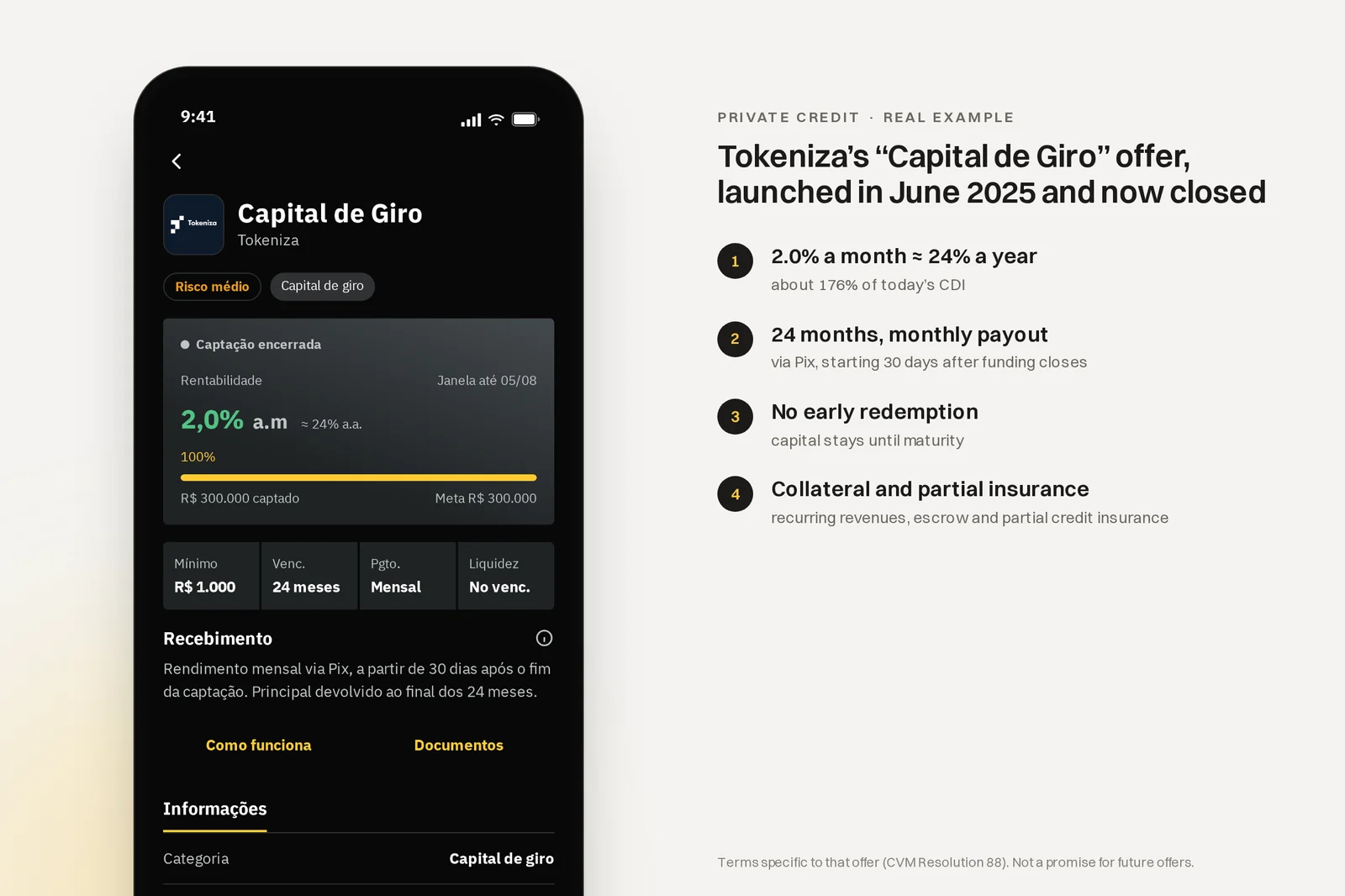
Are you a qualified investor interested in these opportunities?
Request access to private credit offers →
If you already have a diversified portfolio but are not sure how much to allocate to this kind of deal, a professional analysis can help.
Talk to a specialist about your wealth strategy →
Yield in dollars
Diversifying internationally does not have to mean buying US stocks, betting on Bitcoin going up or taking on big market swings.
You can also hold a slice of your wealth in dollar-denominated assets designed to generate recurring yield.
On Chainless, three alternatives deserve attention: Ondo USDY, Maple and Aave.
Although all three are used to earn in dollars, they work in very different ways.
Ondo USDY: US Treasuries as the base of your dollar reserve
If you are looking for dollar yield with a focus on the quality of the underlying assets, USDY is one of the first products to get to know.
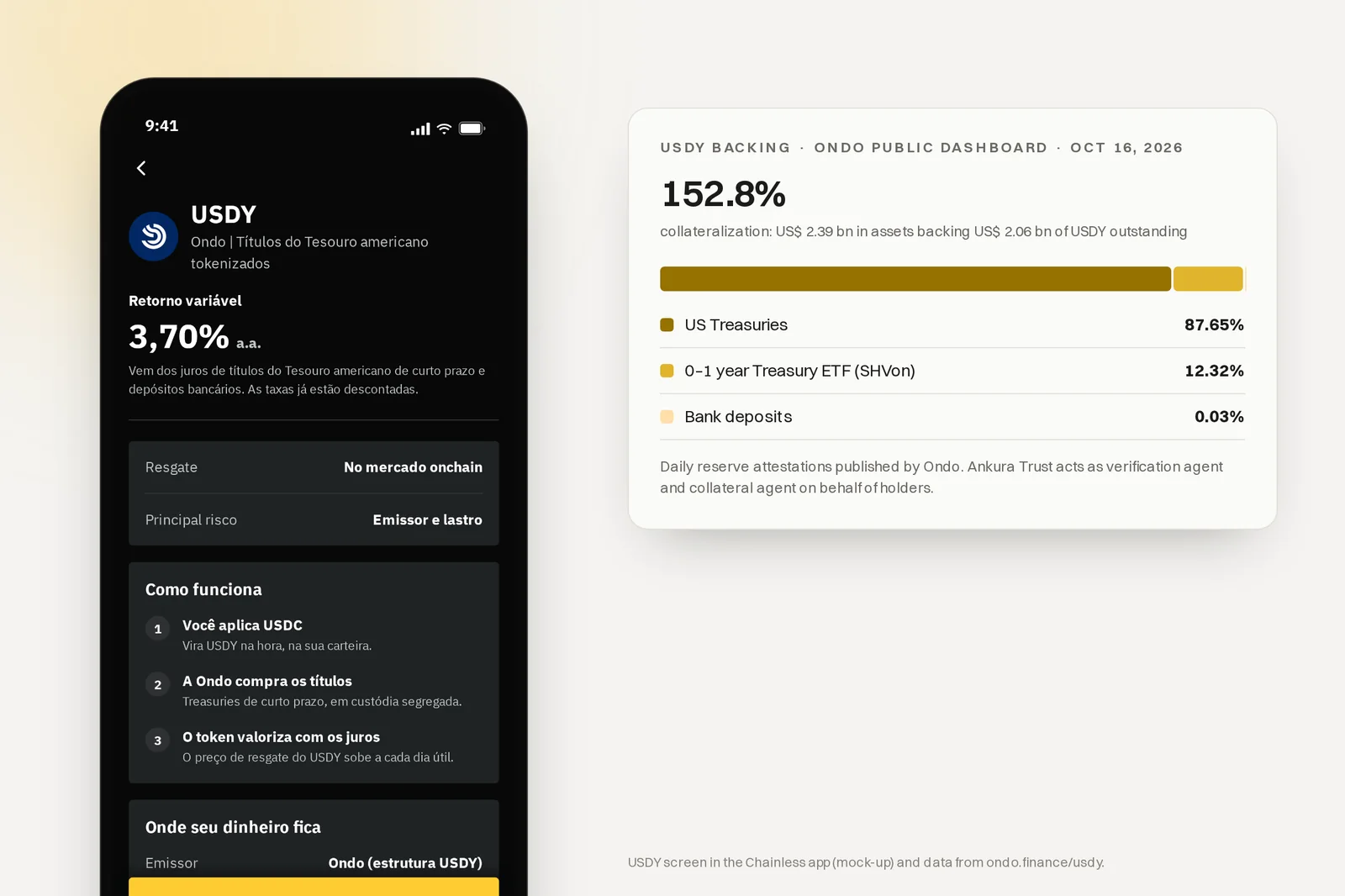
Created by Ondo Finance, USDY is a tokenized debt instrument backed mainly by short-term US Treasuries, plus bank deposits and other instruments allowed by the structure.
Those securities are widely used by institutional investors to manage liquidity and gain exposure to US sovereign debt.
On Chainless, the reference return used in this article is about 3.7% a year in dollars.
It may not look impressive next to Brazilian rates.
But remember: the reference currency is different.
The goal of someone investing in this strategy does not have to be maximizing nominal return in reais. It can be keeping dollars exposed to high-credit-quality assets, with an additional return over time.
What stands behind USDY?
This is one of the most interesting aspects of the product.
USDY is not simply a stablecoin that promises to pay interest.
It is a debt instrument secured by a portfolio of assets, structured with specific investor-protection mechanisms.
The structure includes asset segregation and independent oversight. Ankura Trust acts as verification agent and collateral agent on behalf of USDY holders.
Ondo also publishes reserve attestation reports, so you can track information about the assets backing the product. On October 16, 2026, Ondo’s public dashboard showed US$ 2.39 billion in assets backing US$ 2.06 billion of USDY outstanding, a 152.8% collateralization ratio, with 87.65% in US Treasuries.
This does not mean Ankura guarantees the investor’s capital, nor that USDY is a security issued directly by the US government. The investor holds Ondo’s tokenized instrument, subject to its risks and terms.
That is exactly why the quality of the underlying assets and the product’s legal structure matter so much.
Who is it for?
Imagine most of your wealth is in Brazil.
Your income comes from a Brazilian company. Your properties are in Brazil. Your traditional investments are concentrated in reais too.
You want to start building an international reserve, but you do not want that slice exposed to the swings of stocks or crypto.
USDY can make sense as one of the more conservative components of that international exposure.
It lets you seek wealth growth in dollars with an economic base tied mainly to US sovereign debt.
And because it is tokenized, it can be held in your own digital wallet instead of depending solely on a traditional broker’s infrastructure.
It is a step up from simply holding digital dollars with no yield: you keep your dollar exposure and gain a source of return.
Even so, there are risks tied to the issuer, the legal structure, the backing, liquidity and trading of the token.
USDY has onchain trading and redemption mechanisms, but actual conversion depends on the applicable rules and on available liquidity. Do not assume every exit will be immediate or free of price variation.
In short
USDY is especially interesting for those seeking dollar diversification who prioritize high-quality underlying assets and a strategy with lower credit risk relative to the other dollar-yield options covered here.
For that profile, a few extra percentage points are not always worth significantly higher risk.
Discover Ondo USDY on Chainless →
Maple: seeking more dollar yield through institutional credit
Now imagine you already have a relatively conservative dollar reserve.
You understand its role, but you want part of your dollar holdings to aim for higher returns.
This is where Maple enters the conversation.
Maple is an onchain credit management platform that connects investor capital to financing deals, mainly with institutional borrowers.
Instead of picking a single credit deal, as with Tokeniza’s individual offers, the investor can access strategies that pool different loans under specialized management.
These operations include credit analysis, borrower monitoring and collateral mechanisms.
The yield comes essentially from the interest paid by the borrowers.
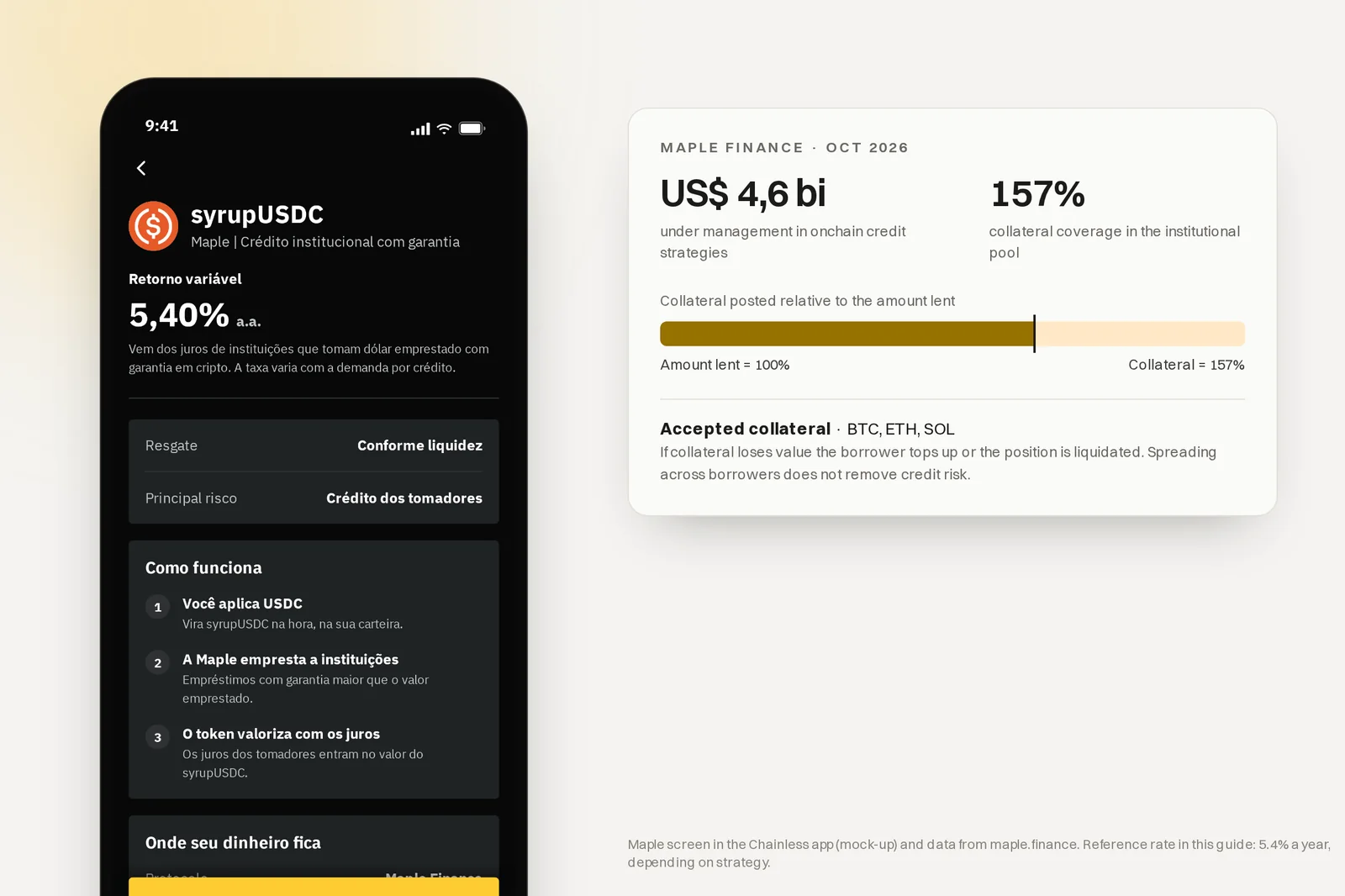
At the references used in this guide, certain Maple strategies pay about 5.4% a year in dollars.
Why does Maple pay more than US Treasuries?
Because we are moving from financing a government to taking on exposure to institutional credit.
The rate difference pays for additional risks, such as borrower defaults, falling collateral values and possible difficulty recovering the credit.
In overcollateralized lending strategies, borrowers have to post collateral worth more than the amount they borrow.
For example, an institution that wants to borrow dollars can post crypto assets such as Bitcoin or Ether as collateral, under each deal’s criteria.
If the value of that collateral falls, additional top-ups can be required or liquidation mechanisms triggered.
Spreading capital across different loans can also reduce dependence on any single borrower.
But diversification does not remove every risk: a market crisis can hit several borrowers or collateral assets at once.
Who is it for?
Maple can make sense for the investor looking for a middle ground between instruments backed by government securities and higher-risk strategies.
Someone who wants to raise the return of their dollar portfolio but has no interest in buying volatile crypto may find this an interesting alternative.
The central point here is to understand that the extra return comes with exposure to the credit market.
It is a portfolio-building strategy, not a guarantee of higher return with no trade-off.
Liquidity deserves attention too
Maple has different products and investment formats, each with its own redemption mechanisms.
Depending on the strategy, withdrawal can happen through available liquidity, by trading the token or through redemption windows. In exceptional conditions there can be delays or restrictions.
Before investing, check the specific terms of the product shown in the app.
This matters especially if you plan to use the position as a reserve you may need to move at short notice.
Aave: dollar yield directly through decentralized finance
Our last alternative works differently from the previous ones.
Aave is one of the best-known lending protocols in decentralized finance, or DeFi.
Unlike traditional credit structures, where an institution assesses the borrower, loans on Aave are organized by smart contracts running on the blockchain.
It works like this:
Investors supply assets, such as dollar-denominated stablecoins, to lending markets.
Others can borrow those assets, as long as they post the collateral the protocol requires.
The interest paid by borrowers is distributed to liquidity providers according to the market’s rules.
If a loan position crosses the protocol’s risk limits, it can be liquidated to protect the system.
All of this runs through smart contracts, with no bank performing the conventional intermediation of each loan.
Where does the yield come from?
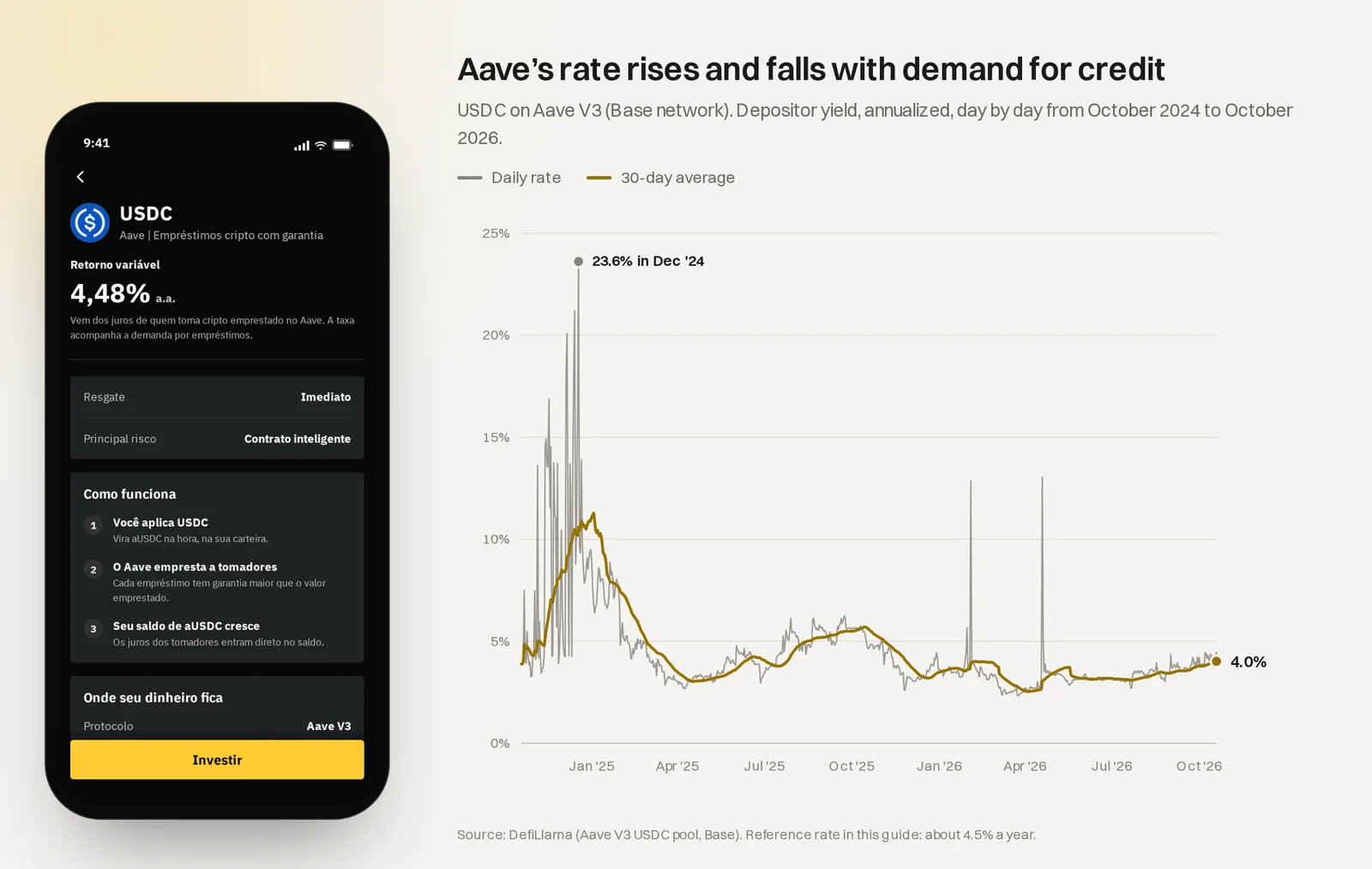
Aave’s most important trait is that interest rates move with the supply of and demand for credit.
When many people want to borrow dollars and little liquidity is available, rates tend to rise.
When there are lots of dollars deposited and little demand to borrow, rates tend to fall.
That is why Aave can become especially interesting at certain moments in the crypto market.
In periods of higher activity, rising asset prices and demand for leverage, borrowing demand can increase and push rates up.
But that relationship is not guaranteed. It depends on the conditions of each market.
The reference used in this guide is about 4.5% a year, but that rate can change significantly, even over short periods. In the chart below, the same USDC position on Aave went from peaks above 20% a year in late 2024 to somewhere between 3% and 5% through 2026.
What are the risks?
On Aave you do not depend on a specific company promising to pay interest on an individual loan.
That reduces direct exposure to certain credit models, but introduces another category of risk.
The main one lies in the protocol’s technological and economic infrastructure.
Smart contract failures, price oracle problems, insufficient liquidations in extreme events, risks in the assets used and liquidity difficulties can all cause losses.
There is also the risk that the stablecoin you supply loses its peg to the dollar or faces restrictions imposed by its issuer.
Aave has security and risk-management mechanisms, but they do not eliminate the possibility of loss.
Who is it for?
Aave is especially interesting for investors who understand how DeFi works and want to diversify their sources of yield.
It offers exposure to a credit market that operates differently from traditional structures.
Aave’s role in a portfolio, then, does not depend only on the rate on offer today.
There may be periods when its return is very competitive and others when alternatives such as Maple or USDY offer a better balance of risk and return.
That is why Aave tends to make the most sense as a position you monitor and adjust as market conditions change.
You do not need to invest in every available alternative. What matters is understanding what each one adds to your portfolio.
So which of these should you choose?
Now that we understand how each product works, we can return to the opening question.
Which one is best?
The answer depends far less on which rate is highest today and far more on the job that money needs to do.
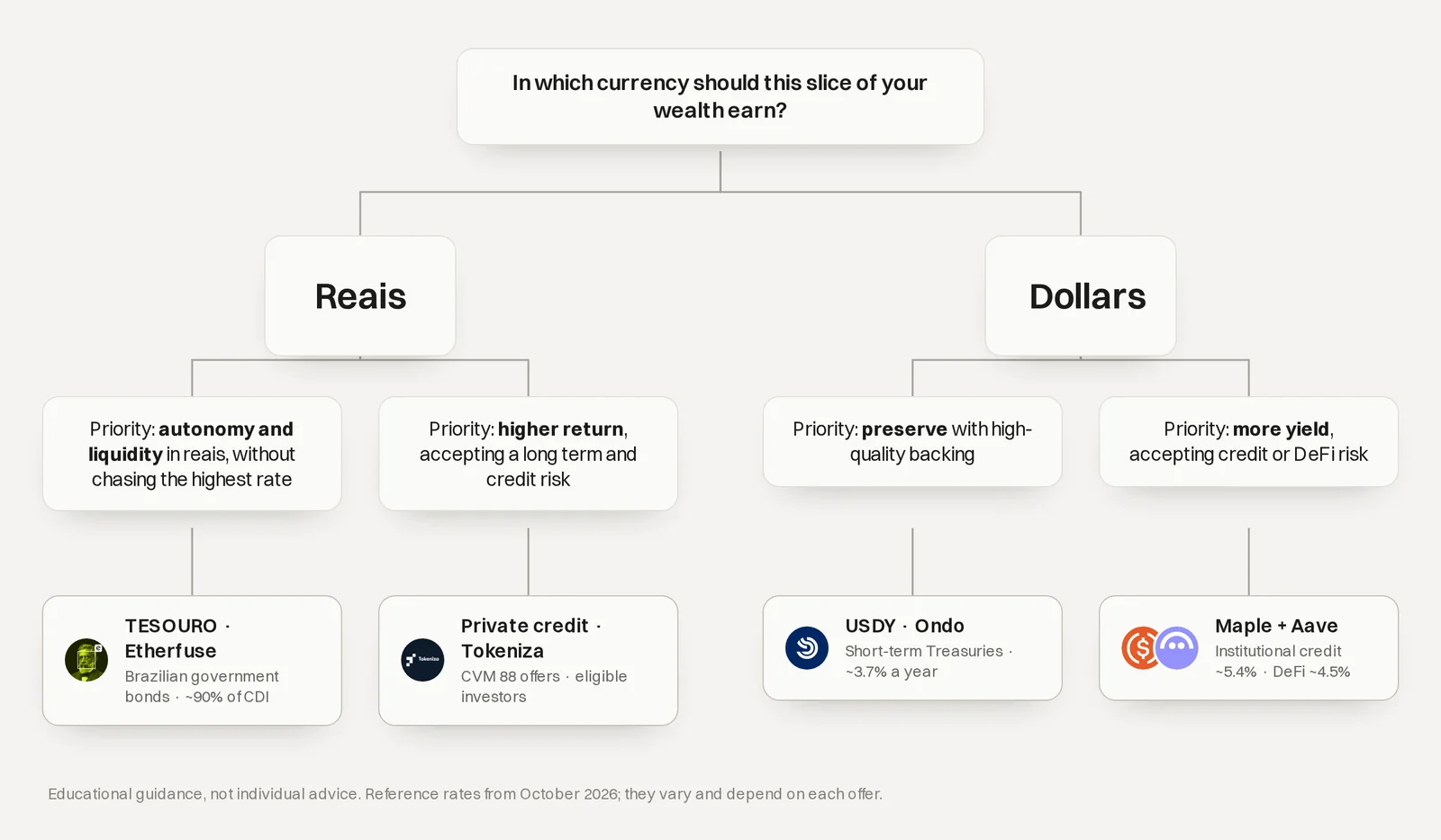
Let’s organize it into four situations.
Profile 1: I want to hold wealth in reais with more autonomy
You have commitments in Brazil and want to keep part of your funds in reais, while reducing concentration in traditional institutions.
In that case, TESOURO can be a coherent alternative.
Its main proposition is not to maximize return, but to offer exposure to Brazilian government bonds in a tokenized structure.
Size the investment with your liquidity needs and the operational risk of converting back to reais in mind.
Profile 2: I want to build a wealth reserve in dollars
Your portfolio is concentrated in Brazil and you want to broaden your exposure to international assets without taking on big swings in crypto and stocks.
In that case, USDY can be a starting point to evaluate.
Exposure to the US government securities that make up most of its backing can help build a more conservative dollar-denominated slice of the portfolio.
Profile 3: I want to increase my dollar yield
You already have an organized base and want returns above those tied to US government securities.
Maple can be a way to add institutional credit to the portfolio.
Aave can complement the strategy with a distinct source of yield, driven by the dynamics of the DeFi market.
The result is diversification not only across assets, but across different sources of return and different kinds of risk.
Profile 4: I have a diversified portfolio and want high-yield opportunities
You already have reserves, more conservative positions and international exposure.
In that case, Tokeniza’s private credit deals can be considered as a specific slice of the strategy, provided you meet the eligibility criteria.
The goal is not to replace the whole portfolio with higher-yield assets, but to take on selected risks within a plan that can accommodate possible losses and longer terms.
An important note on diversification
Investing in five different products does not necessarily mean you are well diversified.
Diversification depends on the risks you are spreading.
Two investments can look different and still depend on the same stablecoin, the same blockchain infrastructure or collateral that behaves the same way in a crisis.
On the other hand, combining instruments in different currencies, with different borrowers, different yield mechanisms and complementary liquidity terms can help build more resilient wealth.
That is why picking investments one by one is not enough.
You need to understand how they work together.
What to check before putting your money to work
Whatever product you choose, there are a few questions every investor should ask.
1. Where does the yield come from?
Interest on government bonds? Loans to companies? Demand for dollars in DeFi protocols?
The better you understand who pays the interest, the better you understand the risks involved.
2. In which currency do I want to measure my wealth?
If the goal is to pay expenses in reais, a dollar investment can add unnecessary volatility.
If the goal is international diversification, a high rate in reais may not solve the problem you are trying to address.
3. When might I need this money?
Having liquidity is as important as earning a return.
A reserve you might need tomorrow should not be treated like an investment planned for several years.
And remember: being able to transfer a token at any time is not the same as being able to convert it into cash immediately, without a discount.
4. What can go wrong?
Every investment involves risk.
It can sit in a borrower’s ability to pay, in exchange-rate swings, in the value of collateral, in the token’s legal structure or in smart contracts.
Tokenized assets can also depend on issuers, custodians and service providers, each with their own rules and restrictions.
Self-custody reduces certain dependencies, but it does not remove these exposures.
5. What share of the portfolio makes sense for this investment?
An alternative can be appropriate for 5% of your wealth and inappropriate for 80%.
The percentage depends on your goals, your horizon, your other positions and your ability to absorb losses.
Return should be the consequence of a strategy, not its starting point
Choose the currency, the horizon and the risk that slice of your wealth can carry first. Only then compare rates.
What about the other yield opportunities on Chainless?
The five alternatives in this guide are only part of what is possible.
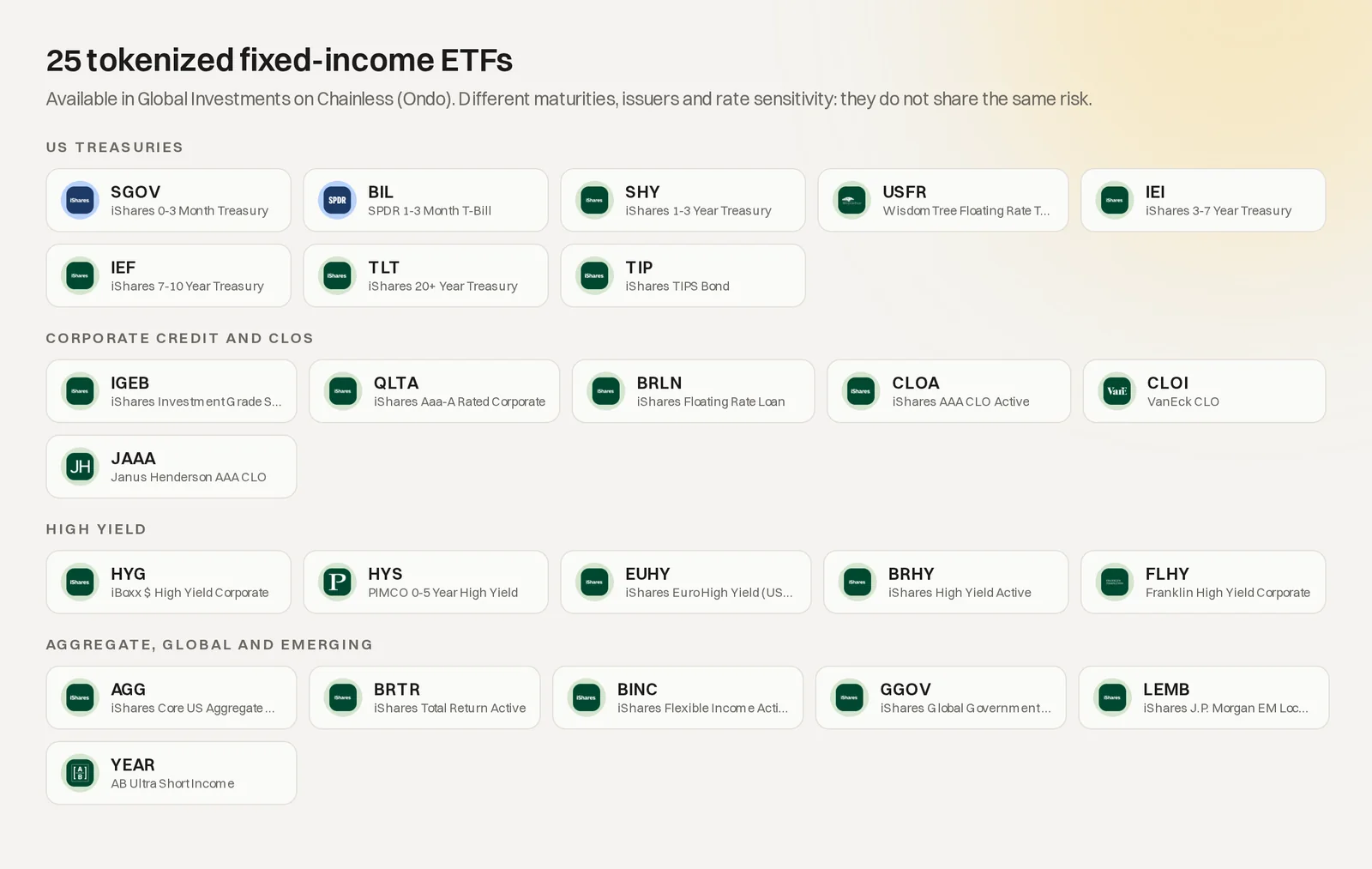
Beyond them, Chainless gives access to a wider universe of tokenized products, including 25 tokenized fixed-income ETFs, which let you explore different segments of the international bond and credit market.
Depending on the ETF, the exposure can involve government securities, corporate debt and different maturities.
These investments have their own characteristics. Some can be quite sensitive to interest-rate changes and price swings, even when the underlying portfolio is made of fixed-income securities.
There are also yield strategies with liquidity pools and other DeFi protocols.
In many of those cases, though, a large part of the result depends on price changes in the assets used, on the pool’s composition and on mechanisms such as trading fees and impermanent loss.
That is why they deserve a separate discussion.
In this first guide we chose to focus on yield alternatives with a clearer reference in reais or dollars.
How to start investing through Chainless
Chainless was built to simplify access to these investments.
You do not need to learn how to operate different protocols, set up a wallet for each network or understand every technical detail of the blockchain to start exploring the available alternatives.
Everything happens in a single app.
Step 1 — Choose your currency. Decide whether you want to hold that slice of your wealth in reais or dollars. You can deposit reais via Pix and use the conversion routes available on the platform.
Step 2 — Get to know the opportunities. Open the Explore tab, go to the Yield list and compare the options by rate, source of return, risks and liquidity.
Step 3 — Invest according to your goal. Choose the asset, review the terms of the operation and confirm the investment.
The assets or tokens corresponding to the position are linked to your self-custodial wallet, according to each product’s structure.
Redemption and transfers follow the investment’s rules, the available liquidity and the services needed for the operation.
Explore the yield alternatives on Chainless →
Your wealth deserves a strategy, not just an interest rate
Throughout this article we looked at different ways to seek yield without relying only on conventional investments.
We saw that it is possible to hold economic exposure to Brazilian government bonds through tokens, build a yield-bearing dollar reserve with assets tied to US Treasuries, access private credit deals and take part in decentralized lending markets.
But the main conclusion is not in any of these technologies.
It is in the way you think about your wealth.
A good portfolio does not have to be made of the investments paying the most at a given moment.
It has to make sense for the life of the person who owns it.
That means considering the commitments you have, the countries and currencies you are exposed to, when you will use the funds and the risks you can take.
At Chainless, we believe the future of wealth lies in combining different asset classes with more autonomy and control.
You should be able to choose where to keep your money, which assets to invest in and how to move your wealth, with less dependence on intermediaries and more clarity about the risks of each decision.
Financial sovereignty is not simply having your assets outside a bank. It is having real alternatives to decide how your wealth will be built, preserved and used.
And none of those decisions should be made by looking only at the highest yield.
Find out which investments make sense for you
If you want to build a more diversified portfolio, protect a slice of your wealth in dollars or get to know the yield opportunities available on Chainless, the first step is understanding your profile.
Talk to a specialist to assess your goals, your liquidity needs, your currency exposure and your risk tolerance.
Discover the investment strategy that fits your profile →
Or explore the available alternatives directly in the app.
Discover Chainless investments →
Chainless. Your wealth, your choices.
Important information
This content is for educational purposes only and does not constitute individual recommendation, investment advice or a public offering of securities by Chainless. The products mentioned are made available by their respective issuers, protocols or partners, subject to the terms and restrictions of each structure. The rates shown are indicative, can change over time and do not guarantee future results. Tokenized investments are subject to credit, market, liquidity, currency, technology, issuer and legal-structure risks, including the possibility of losing capital. These tokens are not covered by Brazil’s FGC deposit guarantee. Applicable tax obligations are the investor’s responsibility. Read each product’s documents and, when needed, seek guidance from a licensed professional before investing.
Yield in reais and in dollars, with self-custody
On Chainless, tokenized government bonds, private credit and DeFi protocols live in the same app, and the tokens stay in your MPC wallet. You pick the currency, compare rate, backing, liquidity and risks, and invest in a few taps. No intermediary holding your money, no seed phrase.
See how it worksPerguntas frequentes
What is the difference between earning in reais and earning in dollars on Chainless?
Yield in reais, such as Etherfuse’s TESOURO and Tokeniza’s private credit offers, matches commitments and opportunities in Brazil and uses the CDI rate as its benchmark. Yield in dollars, such as USDY, Maple and Aave, is for diversifying and protecting part of your wealth in another currency. The right question is not which currency pays more interest today, but in which currency you want to hold that slice of your wealth. Earning 3.7% in dollars is not the same as earning 3.7% in reais: in the 12 months to October 2026, with the dollar falling about 7%, that return measured in reais was negative.
Does Etherfuse’s TESOURO pay more than a bank CD?
Probably not. The reference used in this guide is roughly 90% of CDI, and there are bank products that pay more. TESOURO’s proposition is different: economic exposure to Brazilian government bonds held in custody at B3, in a token that sits in your self-custodial wallet and can move on the blockchain. The benefit is in the access and control structure, not in a promise of higher return.
What is the most conservative option for earning in dollars?
Among the alternatives in this guide, Ondo’s USDY carries the lowest relative credit risk. It is backed mainly by short-term US Treasuries and bank deposits, with reserve attestations published daily and Ankura Trust acting as verification agent and collateral agent. Issuer, legal-structure, liquidity and currency risks still exist. Maple and Aave pay more because they take on exposure to institutional credit and to DeFi protocols.
Who can invest in Tokeniza’s private credit offers through Chainless?
Access is restricted to eligible users, subject to the criteria of each offer, including the investor qualification it requires. These deals can have long terms and little or no secondary trading, so they do not work as an emergency reserve. They make sense as a smaller slice of an already diversified portfolio, sized to absorb possible losses.